
An essential guide to Spanish language certification, assessed skills, exam formats, and choosing the option that meets your academic or professional needs.
Why does choosing the right Spanish certification matter?
Certifying your Spanish language proficiency can be an important step toward academic advancement, professional development, or personal achievement.
However, not every certification exam evaluates the same language skills, and not every institution requires the same type of assessment.
The Servicio Internacional de Evaluación de la Lengua Española (SIELE) offers several examination formats designed to assess different aspects of Spanish language proficiency.
Among these are SIELE Global, S1, and S5, three options that serve different certification purposes.
Understanding their differences is essential before registering for an exam.
What is SIELE?
SIELE is an international Spanish language proficiency assessment system supported by four major academic institutions:
Instituto Cervantes
Universidad Nacional Autónoma de México (UNAM)
Universidad de Salamanca
Universidad de Buenos Aires
One of SIELE’s distinctive characteristics is its pan-Hispanic approach, which recognizes the linguistic diversity of Spanish across different Spanish-speaking communities.
The examination is computer-based and uses the Common European Framework of Reference for Languages (CEFR) to report proficiency from A1 to C1.
Unlike examinations designed for one specific proficiency level, SIELE uses a multilevel assessment approach.
Candidates complete the relevant examination tasks and receive scores corresponding to the proficiency demonstrated.
Which language skills does SIELE assess?
The assessment system consists of four main components:
1. Reading Comprehension (Comprensión de lectura — CL)
Evaluates the ability to understand written texts, identify relevant information, interpret meaning, and recognize relationships between ideas.
2. Listening Comprehension (Comprensión auditiva — CA)
Assesses the ability to understand spoken Spanish in a range of communicative situations.
3. Written Expression and Interaction (Expresión e interacción escritas — EIE)
Measures the ability to produce written texts, organize information, communicate ideas, and respond appropriately to different writing tasks.
4. Oral Expression and Interaction (Expresión e interacción orales — EIO)
Assesses spoken production and interaction through recorded examination tasks.
The combination of these components determines the examination format.
SIELE Global: A comprehensive assessment of Spanish proficiency
SIELE Global is the most comprehensive examination format because it evaluates all four language skills.
It is designed for candidates who need a broad assessment of their Spanish proficiency rather than evidence of selected competencies.
The examination includes:
| Component | Duration |
|---|---|
| Reading Comprehension | 60 minutes |
| Listening Comprehension | 55 minutes |
| Written Expression and Interaction | 50 minutes |
| Oral Expression and Interaction | 15 minutes |
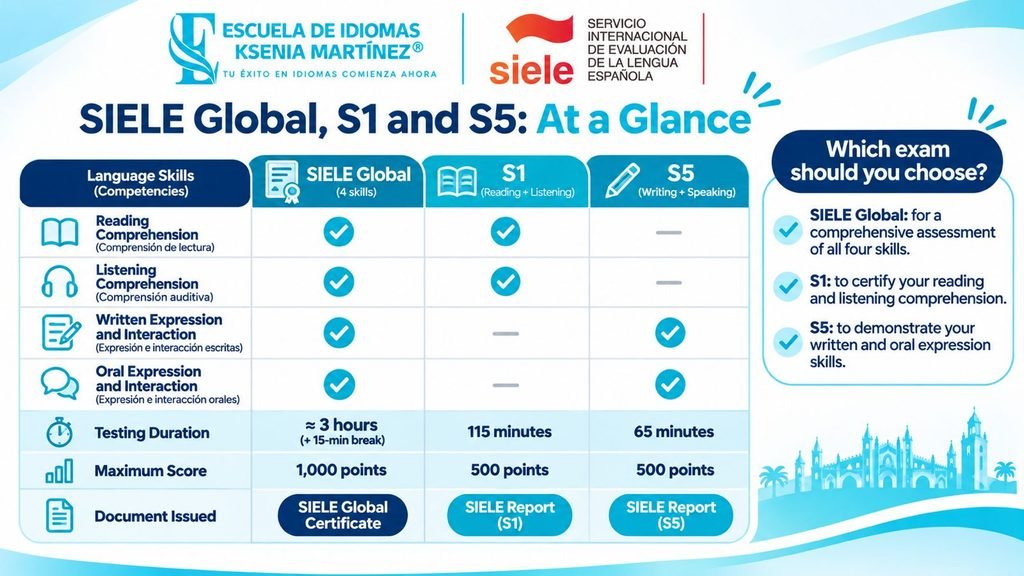
The examination lasts approximately three hours of testing, with an additional scheduled 15-minute break.
Each component carries a maximum of 250 points, producing a total possible score of 1,000 points.
Who should consider SIELE Global?
This format may be particularly relevant for candidates who need to demonstrate comprehensive Spanish language proficiency for:
University admissions or academic mobility.
Professional applications involving several language skills.
Educational programs requiring a complete language proficiency profile.
Personal certification objectives involving all four competencies.
Candidates receive an internationally recognized SIELE Global Certificate, showing the scores obtained in each component and an overall result.
However, candidates should always verify the specific requirements of the institution requesting certification.
Recognition of SIELE does not necessarily mean that every institution accepts every format or proficiency result.
SIELE S1: Reading and Listening Comprehension
The S1 modality evaluates two receptive language skills:
Reading Comprehension (CL) and Listening Comprehension (CA).
Receptive skills refer to the ability to understand and process linguistic information presented in written or spoken form.
The examination includes:
| Component | Duration |
|---|---|
| Reading Comprehension | 60 minutes |
| Listening Comprehension | 55 minutes |
| Total | 115 minutes |
Each component has a maximum score of 250 points, giving S1 a total possible score of 500 points.
What does S1 measure?
The reading component assesses the candidate’s ability to interpret written information across texts of varying complexity.
The listening component examines the ability to understand spoken messages and identify relevant information in different contexts.
Together, these tasks provide evidence of the candidate’s Spanish comprehension skills.
When might S1 be appropriate?
S1 may be suitable when an educational institution, employer, or other organization specifically requires evidence of reading and listening comprehension.
It may also be relevant to candidates who need a formal assessment of these particular competencies.
However, S1 does not assess written production or spoken expression.
Consequently, it should not be presented as equivalent to a comprehensive four-skill certification.
Candidates completing S1 receive a SIELE Report (Informe SIELE) indicating their results in the two assessed components.
SIELE S5: Written and Oral Expression
The S5 modality focuses on two productive language skills:
Written Expression and Interaction (EIE) and Oral Expression and Interaction (EIO).
Productive skills involve the ability to formulate and communicate messages through writing or speaking.
The examination includes:
| Component | Duration |
|---|---|
| Written Expression and Interaction | 50 minutes |
| Oral Expression and Interaction | 15 minutes |
| Total | 65 minutes |
The maximum combined score is 500 points.
What does S5 measure?
The written component evaluates the candidate’s ability to organize ideas, produce coherent texts, use appropriate linguistic resources, and respond to specific communicative tasks.
The oral component assesses spoken communication through digitally recorded tasks.
These activities provide evidence of the candidate’s ability to express information, develop ideas, and communicate in Spanish.
When might S5 be appropriate?
S5 may be a relevant option when a candidate needs to demonstrate written and spoken communication abilities for a specific academic or professional purpose.
Nevertheless, its suitability depends on the requirements of the institution requesting certification.
S5 does not include independent reading or listening comprehension tests.
Candidates receive a SIELE Report showing their results in the written and oral components.
SIELE Global vs. S1 vs. S5: A comparison
| Feature | SIELE Global | S1 | S5 |
|---|---|---|---|
| Reading Comprehension | Yes | Yes | No |
| Listening Comprehension | Yes | Yes | No |
| Written Expression | Yes | No | Yes |
| Oral Expression | Yes | No | Yes |
| Testing duration | 3 hours | 115 minutes | 65 minutes |
| Maximum score | 1,000 | 500 | 500 |
| Document issued | Certificate | Report | Report |
| CEFR reference | A1–C1 | A1–C1 | A1–C1 |
Important: A shorter examination does not necessarily mean an easier examination.
Each format assesses a different combination of linguistic competencies. The appropriate choice depends on which skills must be demonstrated.
How to choose the right SIELE examination
Before registering, candidates should consider three essential questions.
1. Why do I need Spanish language certification?
The first step is to establish the purpose of the examination.
Are you applying to a university? Preparing for an international academic program? Seeking professional recognition? Or evaluating your personal language development?
Different objectives may involve different certification requirements.
For example, a university requesting evidence of all four language skills may require a complete examination, whereas another institution may accept a report covering specific competencies.
Always confirm the accepted examination format directly with the receiving institution before registering.
2. Which language skills must I demonstrate?
Spanish proficiency includes several interconnected but distinct competencies.
A candidate who understands complex written texts may not necessarily demonstrate equivalent proficiency in spoken interaction.
Likewise, someone who communicates effectively in conversation may require further development in academic writing.
A comprehensive assessment provides a broader proficiency profile, while an independent modality focuses on selected skills.
Understanding this distinction is essential when choosing between SIELE Global, S1, and S5.
3. What is my current Spanish level?
Although SIELE is a multilevel assessment, knowing your current level can help you prepare more effectively.
A preliminary language assessment may identify strengths and areas requiring further attention.
This information can support the development of a realistic preparation plan, including practice with examination tasks, time management, and specific linguistic competencies.
Preparation should not focus exclusively on achieving a particular score. It should also contribute to developing the skills that the examination is designed to measure.
Understanding SIELE results and validity
One of SIELE’s important characteristics is the relationship between examination scores and the CEFR.
Rather than providing a traditional pass-or-fail result for a single predetermined level, SIELE reports the proficiency demonstrated in the assessed components.
SIELE Global Certificate
Candidates completing all four components receive a certificate showing:
The scores obtained in each examination component.
The corresponding CEFR proficiency information.
The total score, out of 1,000 points.
SIELE Independent Modality Report
Candidates completing S1 or S5 receive a report containing the results of the specific components taken.
These reports demonstrate assessed competencies but do not automatically replace a complete four-skill certificate when one is required.
How long are SIELE results valid?
Both SIELE Global Certificates and Independent Modality Reports are valid for five years.
Results are made available within a maximum of three weeks after the examination.
Candidates access their documents electronically through the official SIELE platform.
SIELE certification in Playa del Carmen, Mexico
Escuela de Idiomas Ksenia Martínez® is an Authorized SIELE Examination Center in Playa del Carmen, Quintana Roo, Mexico.
Our center offers examination sessions for SIELE Global, S1, and S5, allowing candidates to select the format appropriate to their certification needs.
Upcoming examination session
Date: Saturday, November 21, 2026
Time: 11:00 AM (Playa del Carmen local time)
Available formats: SIELE Global, S1, and S5
Location: Playa del Carmen, Quintana Roo, Mexico
Capacity: Limited to three candidates for this session.
Registration and seat availability are subject to the official booking process.
For information about examination formats, registration procedures, and our authorized examination center, visit:
SIELE Examination Center — Escuela de Idiomas Ksenia Martínez®
Choose the certification that matches your goals
SIELE offers candidates the flexibility to assess Spanish language proficiency according to different academic, professional, and personal objectives.
However, choosing the right examination requires more than comparing duration or the number of tasks.
SIELE Global evaluates four language skills, S1 focuses on reading and listening comprehension, and S5 assesses written and oral expression.
Each option has a distinct purpose.
Before registering, candidates should identify which competencies they need to certify, confirm the requirements of the receiving institution, and consider their current language proficiency.
At Escuela de Idiomas Ksenia Martínez® we believe that language assessment should be understood as part of a broader educational process: one that recognizes existing competencies, identifies areas for development, and supports informed academic decisions.
The right examination is not necessarily the one with the most components. It is the one that provides the evidence of language proficiency you actually need.
Official references
Instituto Cervantes. SIELE: Examination Structure and Components.
https://controlcalidad.examenes.cervantes.es/es/siele/como
Instituto Cervantes. SIELE: Frequently Asked Questions.
https://examenes.cervantes.es/es/siele/preguntas-frecuentes
Instituto Cervantes. SIELE: Scores and Certification Documents.
https://examenes.cervantes.es/es/siele/calificaciones
SIELE. Official Guide for Examination Preparation.
https://siele.org/documents/10180/84852/Gu%C3%ADa_Oficial_Preparadores.pdf
Deja un comentario