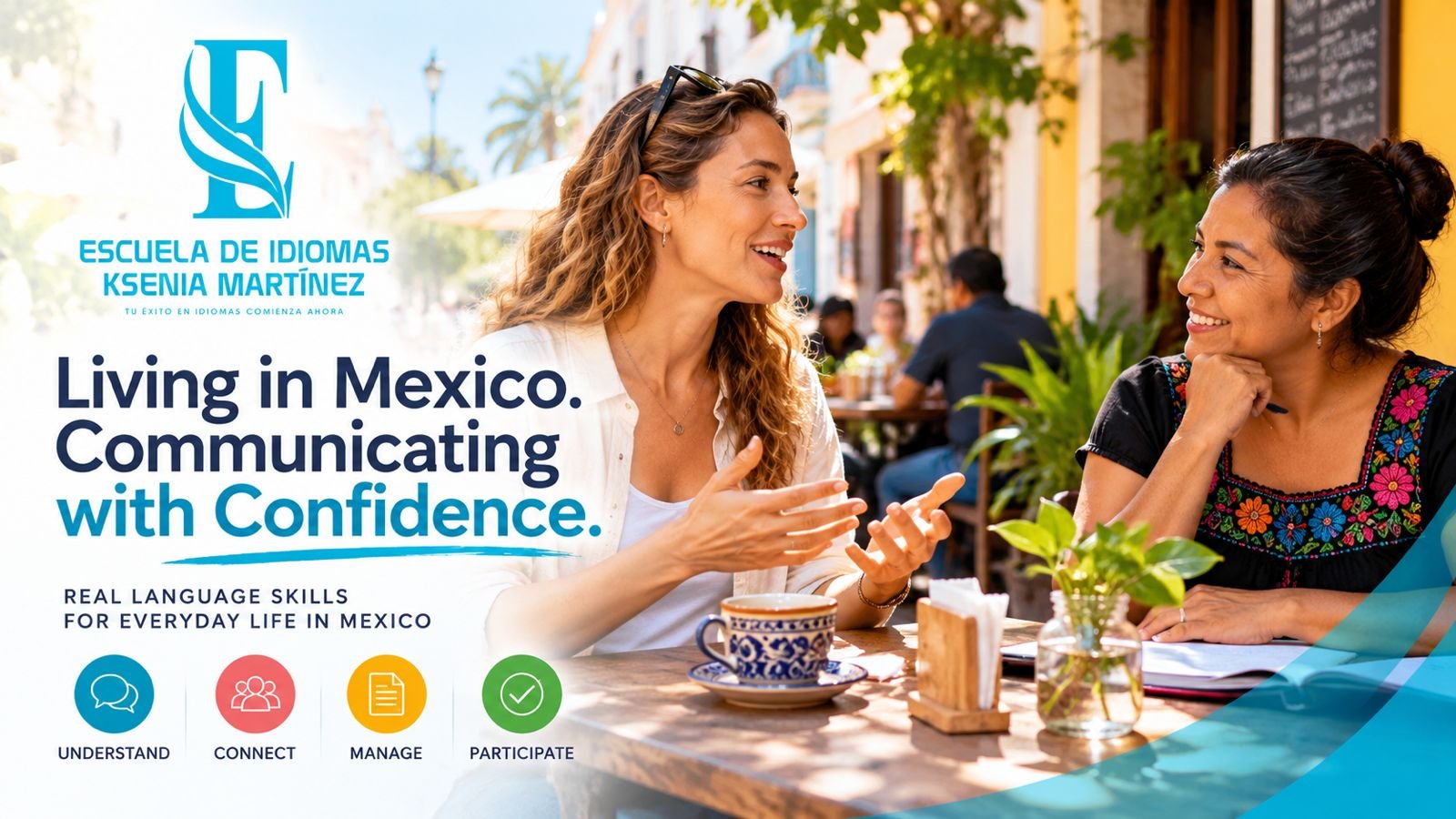
Living in Mexico gives you countless opportunities to encounter Spanish. But being surrounded by a language does not automatically mean being able to use it confidently in everyday life.
You may recognize familiar words, understand simple conversations, or manage basic interactions, yet still struggle when you need to explain a problem, handle paperwork, or express a concern.
This raises an important question:
What do you actually need to be able to do in Spanish to navigate everyday life in Mexico?
1. Understand and Respond in Everyday Situations
Shopping, requesting information, arranging services, and interacting with people in your community all involve different communication skills.
Memorizing useful phrases can be a good starting point, but real communication also requires understanding responses, asking follow-up questions, and adjusting what you say when something is unclear.
For example, when asking about a service, you may need to understand not only the price but also the conditions, schedule, and available options.
Communication is an exchange, not simply a collection of memorized expressions.
2. Explain Your Needs and Handle Unexpected Situations
One of the most valuable skills when living abroad is being able to explain what you need.
Imagine visiting a doctor, reporting a water leak, arranging a repair, or resolving a problem with a service provider.
These situations require you to describe what is happening, provide relevant details, understand questions, and confirm important information.
Expressions such as “No funciona desde ayer” (It hasn’t worked since yesterday), “¿Podría explicármelo nuevamente?” (Could you explain that again?), or “¿Qué debo hacer después?” (What should I do next?) can make a meaningful difference.
Communicative independence develops when you learn to handle real situations, even without knowing every word.
3. Handle Paperwork and Understand Important Information
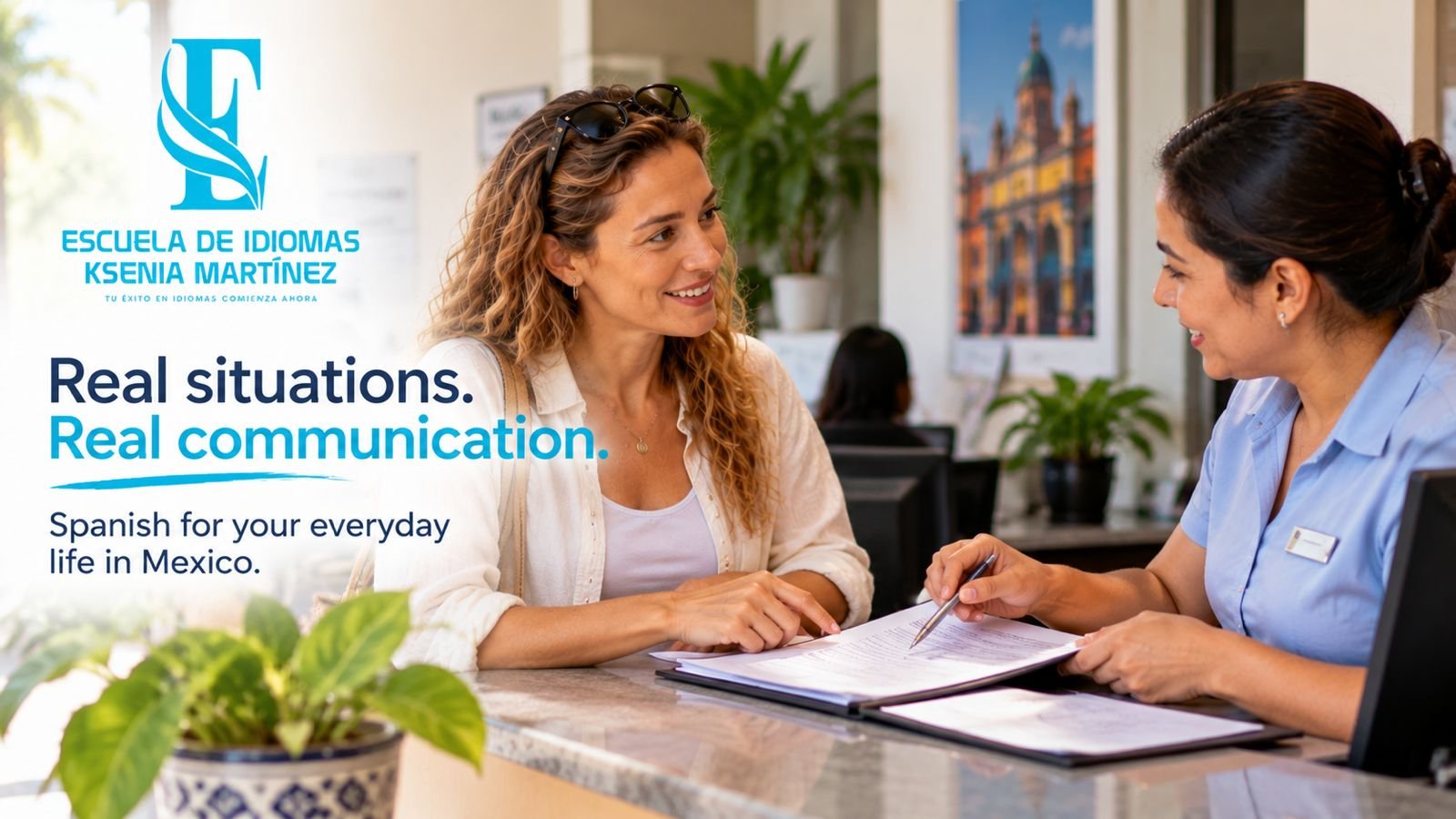
Everyday life may also involve communicating with banks, institutions, businesses, and service providers.
Opening a bank account, asking about required documents, understanding procedures, or scheduling appointments often involves language that differs from casual conversation.
Useful skills include:
-Identifying key information in documents and messages.
-Asking clear and relevant questions.
-Understanding instructions and procedures.
-Requesting clarification when something is unclear.
-Confirming dates, amounts, conditions, and responsibilities.
You do not need to master specialized terminology immediately. The goal is to develop communication strategies that allow you to participate more independently.
Understand How People Communicate in Mexico
Spanish is not used in exactly the same way everywhere.
In Mexico, expressions such as “ahorita,” “con permiso,” “¿gusta?” and “mande” are part of everyday communication. Their meaning and social function may not always be obvious from a literal translation.
Tone of voice, politeness conventions, levels of formality, and context all influence how messages are interpreted.
For example, understanding whether an expression is an invitation, a polite response, or an indirect way of communicating something can help you interact more naturally.
Learning Spanish in Mexico also involves understanding the cultural and social context in which the language is used.
This cultural awareness can be especially valuable when communicating with neighbors, colleagues, service providers, and other members of the community.
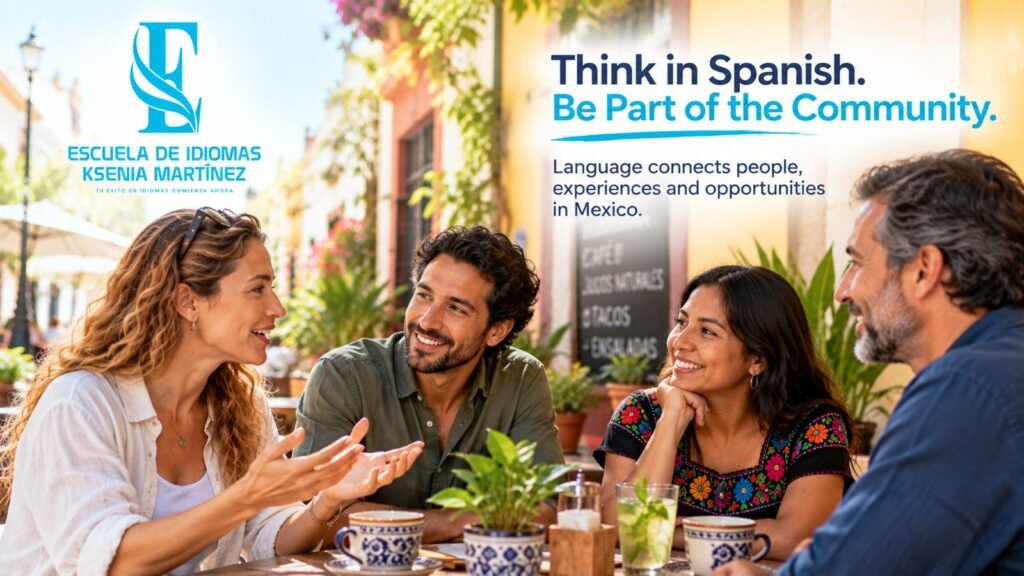
5. Participate in Conversations and Build Relationships
Being able to communicate in Spanish is not only about completing practical tasks.
It also means sharing experiences, expressing opinions, understanding different perspectives, and building personal or professional relationships.
For many foreigners, this is an important part of feeling connected to their community.
Spontaneous conversations can be challenging because they require you to listen, interpret, respond, and react in real time.
Unlike structured classroom exercises, everyday interactions are often unpredictable. People may speak at different speeds, use unfamiliar expressions, or change topics unexpectedly.
These abilities develop through meaningful communication practice, exposure to different situations, and constructive feedback.
Learning to participate in conversations is an essential step toward greater confidence and independence.
6. What Level of Spanish Do You Really Need?
There is no single language level that guarantees confidence in every situation.
The Common European Framework of Reference for Languages (CEFR) describes language proficiency in terms of what learners can understand and do.
In general:
-A1–A2: You begin to manage familiar, predictable situations, communicate basic needs, and participate in simple exchanges.
-B1: You can handle many everyday situations more independently, describe experiences and problems, and explain plans.
–B2: You can participate more fluently in complex discussions, express and support opinions, and understand a broader range of communication.
However, two people with the same language level may have very different communication needs.
Someone learning Spanish for personal interactions may have different priorities from someone who works with clients, manages a business, or frequently interacts with institutions.
That is why learning goals should reflect not only your current level but also the situations in which you need to use Spanish.
7. From Everyday Communication to Official Certification: When Does It Matter?
Being able to communicate confidently in Mexico is an important achievement. But what happens when you need to demonstrate your Spanish proficiency beyond everyday interactions?
You may be comfortable speaking with neighbors, handling appointments, or communicating with service providers. However, an academic institution, employer, or professional opportunity may require more than your personal assessment of your language skills.
This is where official language certification can become relevant.
An internationally recognized Spanish proficiency assessment provides a structured way to evaluate language abilities according to established criteria. Depending on the examination, it may assess reading comprehension, listening comprehension, written expression, and oral communication.
Importantly, being able to communicate in everyday situations and performing well in a language proficiency assessment are related, but distinct abilities.
For example, you might feel confident discussing familiar topics but find it challenging to understand a complex written text, organize an argument, or respond to unfamiliar questions under examination conditions.
Preparing for certification can therefore help you:
–Evaluate your current proficiency and identify areas that require further development.
–Strengthen different communication skills, including those you may use less frequently in everyday life.
-Set measurable learning objectives based on the requirements of a particular assessment.
–Demonstrate your Spanish proficiency when formal evidence is required for academic or -professional purposes.
Not everyone who lives in Mexico needs a Spanish language certificate. For some learners, communicating independently in daily life is the primary goal. For others, formal certification represents an important step toward further academic, professional, or personal opportunities.
The key is understanding the difference between learning Spanish to navigate everyday life and preparing to demonstrate your proficiency through an internationally recognized assessment.
Both paths benefit from a solid foundation in communicative competence, but each requires learning objectives adapted to the individual’s needs.
8. Learn Spanish with Real Communication Goals
An effective learning process begins with understanding the learner’s needs.
This includes their current proficiency, daily environment, activities, interests, and communication challenges.
From there, it becomes possible to establish meaningful objectives and design learning activities that connect classroom practice with real-life situations.
For example, rather than only memorizing health-related vocabulary, learners can practice describing symptoms, understanding instructions, and asking questions during a medical appointment.
Similarly, someone who regularly communicates with Mexican clients may benefit from practicing professional interactions, explaining services, managing requests, and responding appropriately in different business situations.
Learning becomes more effective when language objectives are connected to meaningful communication tasks.
A personalized approach also allows learners to progress toward different goals, whether they want to communicate more confidently in everyday life, develop professional language skills, or prepare for an internationally recognized proficiency assessment.
Conclusion: Learn Spanish to Participate, Not Just to Understand
Navigating everyday life in Mexico requires more than recognizing vocabulary or completing grammar exercises.
It involves understanding others, expressing your needs, managing situations, and participating in your community with increasing independence.
Grammar and vocabulary are essential tools, but their value becomes clear when you can use them to communicate.
The question is not only how much Spanish you know, but what you can do with the Spanish you know.
At Escuela de Idiomas Ksenia Martínez®, we focus on developing communicative competence through learning experiences adapted to each student’s proficiency level, objectives, and individual needs.
Whether your goal is to communicate more confidently in Mexico, improve your professional Spanish, or work toward formal language certification, meaningful progress begins with understanding what you need to achieve.
Learning a language also means expanding your opportunities to participate in the world around you.
Deja un comentario