
This article is also available in Spanish: https://escueladeidiomaskseniamartinez.com/un-idioma-tambien-cuenta-la-historia-de-quienes-lo-hablan-diversidad-del-espanol-y-encuentro-de-culturas/
When we learn a language, we often begin with its words, sounds, and grammatical structures. Yet behind every expression lies something deeper: the history of the people who use it, the places they inhabit, and the experiences they have shared over time.
Languages are not static systems. They evolve alongside societies, adopt new words, preserve older expressions, and reflect interactions between different communities.
Spanish is a particularly interesting example of this process. Its presence across several continents and its remarkable diversity demonstrate how a shared language can develop distinct characteristics depending on the historical, geographical, and cultural contexts in which it is spoken.
On October 12, these characteristics invite us to reflect on the relationship between language, history, and identity, as well as the importance of recognizing the many voices that make up the Spanish-speaking world.
Languages as Witnesses to History
Every language carries traces of its past.
Vocabulary, everyday expressions, and regional ways of speaking can reveal patterns of migration, trade, social transformation, and interaction between communities.
Spanish, for example, developed from the Latin spoken on the Iberian Peninsula. Throughout its evolution, it was influenced by other languages and cultures, including Arabic, whose historical presence left a lasting mark on Spanish vocabulary.
Words such as almohada (pillow), aceite (oil), and ojalá (hopefully or if only) are examples of this linguistic heritage.
These elements remind us that no language develops in historical isolation. Its evolution is closely connected to the events and human relationships that shape societies.
Studying a language can therefore become another way of exploring history.
Spanish in the Americas: A History of Contact and Transformation
The arrival of Spanish in the Americas at the end of the fifteenth century marked the beginning of profound historical, political, social, and linguistic transformations.
This process was closely associated with colonization, the establishment of new power structures, and inequalities that deeply affected Indigenous peoples.
At the same time, contact between Spanish and the many languages already spoken throughout the Americas led to important changes in vocabulary and communication.
Over the centuries, Spanish developed distinctive characteristics across different American territories. The experiences of its speakers, geographical realities, and interactions with other languages all contributed to its diversification.
Speaking about Spanish in the Americas, therefore, does not mean referring to a single, uniform way of using the language.
Instead, it means recognizing a wide range of linguistic varieties that reflect different regional and cultural histories.
Mexico: A Country of Linguistic Diversity
Mexico offers a particularly meaningful example of this richness.
Although Spanish is the most widely spoken language in the country, it coexists with numerous Indigenous languages that form an essential part of Mexico’s cultural and linguistic heritage.
These include Nahuatl, Mayan languages, Mixtec, Zapotec, and many others, each with its own characteristics, communities of speakers, and traditions.
The influence of Indigenous languages can also be found in everyday Spanish.
Several familiar words have origins connected to these languages:
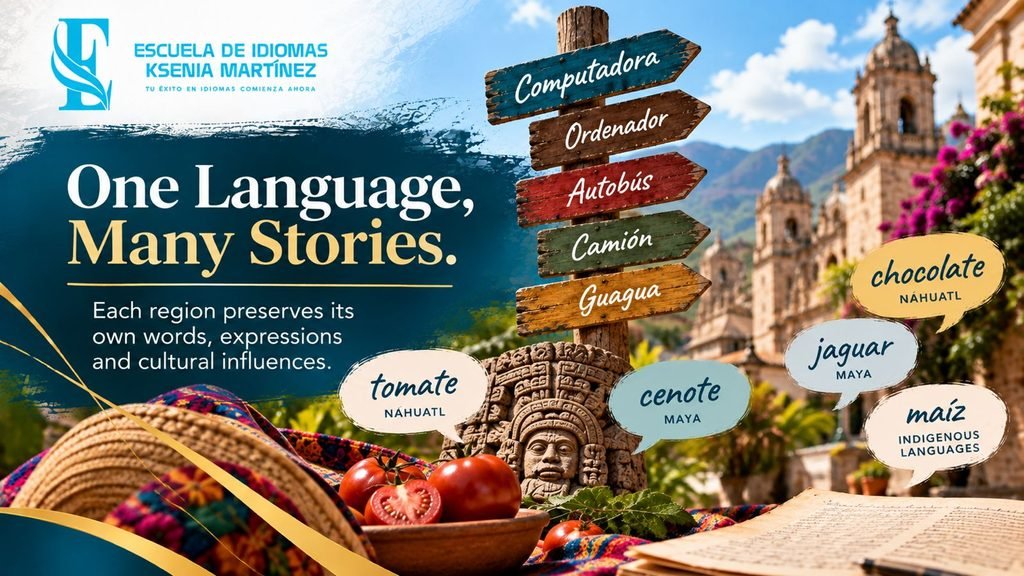
Chocolate: A word historically associated with Nahuatl, although its precise etymological origins remain a subject of scholarly debate.
Tomate (tomato): Derived from the Nahuatl word tomatl.
Cenote: Derived from the Yucatec Maya word ts’ono’ot, associated with natural water-filled sinkholes.
These examples demonstrate how words can preserve references to knowledge, food, landscapes, and cultural realities associated with particular regions.
In the Yucatán Peninsula and Quintana Roo, the continued presence of Yucatec Maya is an important part of regional identity.
Recognizing this diversity means understanding that Mexico’s linguistic history did not begin with the arrival of Spanish. Its Indigenous languages remain living languages, spoken and passed down within their communities today.
One Language, Many Ways of Speaking
One of the most fascinating characteristics of Spanish is its diversity.
Although Spanish speakers share a common linguistic foundation that enables communication across regions, differences exist in pronunciation, vocabulary, intonation, and grammatical usage.
The same object or concept may have different names depending on the country.
For example, what is commonly called a computadora in Mexico is generally known as an ordenador in Spain. Similarly, the word autobús (bus) coexists with regional terms such as camión, colectivo, and guagua, depending on the location and context.
These differences do not represent incorrect versions of Spanish.
They are expressions of the language’s evolution and the identities of the communities that speak it.
Understanding this is particularly important in language education, as learning a language should not be limited to memorizing a single way of expressing oneself.
It also involves developing the ability to recognize different varieties and adapt to diverse communication situations.
October 12: An Opportunity to Reflect on Cultural Encounters
October 12 carries different meanings depending on the country, its history, and the perspectives through which the date is interpreted.
Beyond its official names and commemorations, the date offers an opportunity to reflect on the consequences of European arrival in the Americas, the processes of colonization, the resistance of Indigenous peoples, and the cultural transformations that followed.
Discussing cultural encounters requires acknowledging that these processes did not take place under equal conditions and that they had profound consequences for Indigenous populations, including their languages.
Many communities experienced language displacement, discrimination, and pressure to abandon their native languages.
Valuing cultural diversity, therefore, involves more than celebrating the influences that different societies have had on one another.
It also requires acknowledging historical inequalities, respecting the identities of Indigenous peoples, and understanding the importance of preserving and strengthening their languages.
From an educational perspective, this reflection helps us recognize that no language exists independently of its speakers or the historical circumstances in which it develops.
Learning a Language Also Means Understanding Its Speakers
In foreign language education, grammar and vocabulary are essential, but they do not, by themselves, constitute complete communicative competence.
A person may know a considerable number of words and grammatical structures yet still struggle to interpret certain expressions, conventions of politeness, or cultural references.
Communication also depends on context.
Understanding when to use a particular expression, how to interpret the tone of a conversation, or how forms of address differ across communities is part of developing intercultural competence.
In the case of Spanish, recognizing its diversity helps learners avoid generalizations and understand that Spanish-speaking communities do not necessarily share identical communication habits.
For those learning Spanish in Mexico, this perspective is especially relevant.
Becoming familiar with local expressions, social conventions, and regional characteristics can support more natural and respectful communication.
However, learning one particular variety of Spanish does not make other varieties less valuable.
A comprehensive approach to language education should provide learners with the tools to communicate in different contexts while recognizing the legitimacy of the language’s many varieties.
Linguistic Diversity as Part of Education
Language education has the potential to go beyond teaching rules and linguistic content.
It can encourage curiosity about other cultures, sensitivity to differences, and a greater ability to communicate with people from diverse backgrounds.
This means teaching languages not only as systems of communication but also as expressions of human experience.
From this perspective, linguistic differences should not automatically be viewed as obstacles to overcome. They are realities worth understanding and interpreting.
Learning Spanish, English, Russian, Italian, or any other language involves discovering different ways of organizing communication and expressing ideas, relationships, and experiences.
Linguistic diversity broadens our understanding of the world and reminds us that meaning can be constructed and communicated in many different ways.
Every Language Preserves Many Stories
A language never tells just one story.
Its words, sounds, and expressions carry the experiences of different generations, territories, and communities.
The Spanish we know today is the result of a long historical evolution and numerous linguistic and cultural interactions. Its diversity is an essential part of its richness.
Reflecting on this reality on a date such as October 12 encourages us to recognize both cultural contributions and the historical complexities that have accompanied the expansion and transformation of Spanish.
It also reminds us that the Indigenous languages of the Americas possess their own histories, knowledge systems, and forms of expression. Recognizing and supporting their continued vitality is essential to linguistic diversity.
At Escuela de Idiomas Ksenia Martínez®, we believe that learning a language involves more than acquiring grammatical knowledge. It also means developing communicative and intercultural competencies that help us better understand people and the contexts in which we interact.
Learning a language is also an opportunity to listen to, understand, and appreciate the stories of those who speak it.
Deja un comentario