
Why understanding Mexican culture can change the way you learn and use Spanish
Living in Mexico gives you something that no textbook can fully reproduce: daily contact with the language in its real context.
Spanish is around you when you order coffee, speak to a neighbor, go shopping, ask for information, make an appointment, talk to a colleague or simply listen to conversations happening around you.
But being surrounded by Spanish and actually being able to communicate in Spanish are not necessarily the same thing.
Learning a language involves vocabulary, grammar, pronunciation and communication skills. When you learn it while living in another country, however, there is another important element: culture.
Understanding how people communicate, how language changes depending on the situation and what certain expressions mean in their cultural context can make an important difference in the way you experience everyday life in Mexico.
1.The Spanish you learn and the Spanish you experience
In a language lesson, communication is usually structured. You learn vocabulary, grammatical structures and expressions that help you gradually develop your ability to understand and communicate.
Real life is less predictable.
A conversation may be faster than expected. Someone may use an expression you have never heard before. You may understand every individual word in a sentence and still be unsure what the person actually means.
This does not mean that what you learned was wrong.
It means that language changes when it enters a real social context.
The Spanish you study gives you the foundation. The Spanish you encounter in Mexico gives you the opportunity to learn how that foundation works in authentic situations.
Both are important
2.Language carries culture
Learning Spanish in Mexico is not only about discovering new words. It is also about gradually understanding the cultural information behind them.
Greetings are a simple example.
Knowing how to say buenos días is basic vocabulary. Understanding when people normally use it, how important a greeting can be when entering a small business or starting a conversation, and how the interaction may change depending on whom you are speaking to involves something more than vocabulary.
The same happens with requests, invitations, humor, expressions of politeness and everyday conversation.
Sometimes a grammatically correct sentence can sound unusually direct in a particular situation. In another context, an expression that looks strange when translated literally may sound completely natural to a local speaker.
This is why language and culture are difficult to separate.
Words tell you what is being said. Context helps you understand what is actually happening.
3.Everyday life can become part of your learning
One of the greatest advantages of learning Spanish while living in Mexico is that opportunities to interact with the language are everywhere.
Think about how many situations you encounter during an ordinary week:
ordering at a restaurant, speaking with a service provider, asking a question in a store, talking to neighbors, communicating at work, making a reservation, dealing with an appointment or having a spontaneous conversation with someone you have just met.
Each situation requires slightly different language.
And each one can help you identify what you can already do comfortably and what you still need to develop.
This is where living in Mexico can become an important part of the learning process.
A lesson gives you a controlled environment in which to understand, practice and make mistakes. Everyday life gives you the opportunity to transfer those skills into real communication.
The two environments can complement each other.
4.Why living in Mexico does not automatically make you fluent
There is a common assumption that simply living in another country will eventually make you fluent in its language.
Exposure certainly helps, but exposure alone is not always enough.
It is possible to hear Spanish every day without actively using it. It is also possible to become very good at handling a limited number of familiar situations while finding anything outside those situations difficult.
This can be particularly noticeable in international destinations, where many everyday interactions may also be possible in English.
A person can therefore live in Mexico for a considerable amount of time and still rely on the same basic vocabulary and communication strategies.
Progress requires more than being physically surrounded by a language.
It usually involves active interaction, consistent practice, feedback and gradually expanding the situations in which you can communicate independently.
The objective is not simply to hear more Spanish.
It is to turn exposure into learning.
5.Mexican Spanish: different does not mean incorrect
Students sometimes become concerned when the Spanish they hear in Mexico does not sound exactly like the Spanish they encountered in a textbook, an app or another Spanish-speaking country.
This is completely normal.
Spanish is an international language spoken across many countries and communities. Vocabulary, pronunciation, expressions and communication habits can vary from one region to another.
Learning Spanish in Mexico therefore also means becoming familiar with the language as it is used in your environment.
You may discover local expressions, different names for everyday objects or ways of communicating that you had not encountered before.
This does not mean you need to memorize every regional expression you hear.
A more useful objective is to develop enough linguistic and cultural awareness to recognize variation, understand context and adapt your communication when necessary.
That is a skill that becomes increasingly valuable as your level develops.
6.Spanish can change the way you experience Mexico
At the beginning, learning Spanish may have a very practical purpose.
You want to order food, understand prices, ask for directions or solve everyday problems.
As your communication skills develop, however, the benefits can become much broader.
You may be able to have longer conversations with people you meet. You can understand more of what is happening around you. You can ask questions instead of simply accepting the information you understood. You can participate more actively in professional and social situations.
And perhaps most importantly, you gain access to conversations that would otherwise remain outside your experience.
This is one of the reasons learning the local language can change the experience of living abroad.
Greater linguistic independence can lead to greater cultural access.
7.Your reason for learning Spanish matters
Not every foreigner living in Mexico needs Spanish for the same reasons.
One person may need it primarily for everyday life. Another may work with Mexican colleagues or clients. Someone else may want to communicate with their partner’s family, manage a business, study, travel independently or simply build stronger connections with the community around them.
Those differences matter when deciding what and how to learn.
A person who needs Spanish for professional communication may require different vocabulary and situations from someone whose immediate objective is managing everyday conversations confidently.
That is why a learning process should begin with two fundamental questions:
Where are you now?
What do you need to be able to do in Spanish?
Once those questions are clear, it becomes much easier to establish priorities and build an appropriate learning path.
8.urning everyday experiences into progress
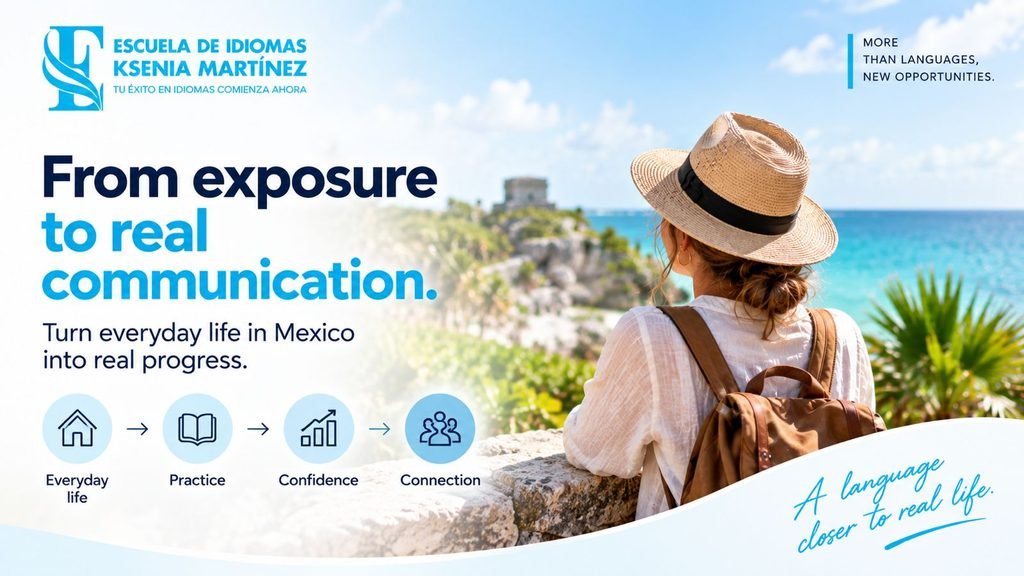
Living in Mexico gives you access to an enormous amount of authentic language. The challenge is learning how to use that environment intentionally.
You do not need to understand every conversation around you or learn dozens of new expressions every day.
Small habits can make a difference.
Pay attention to expressions that appear repeatedly. Notice how people ask for things or respond in familiar situations. Try using something you recently learned instead of automatically switching to another language. Write down a phrase you heard but did not understand and explore it later.
Most importantly, allow yourself to communicate before everything feels perfect.
Real communication is not an exam in which every sentence must be grammatically flawless.
It is an opportunity to discover what you can already do and what you need to learn next.
Learning Spanish means experiencing more
Mexico can be experienced through its places, food, traditions, history and people.
Language gives you access to another layer of that experience: conversations, relationships, humor, everyday interactions and cultural meanings that can be difficult to fully experience from the outside.
Learning Spanish does not mean giving up your own language or identity. Nor does it mean that you need perfect Spanish before you can participate in life around you.
It means gradually gaining another way to communicate with and understand the environment in which you live.
And that process can begin with something as simple as one conversation.
Mexico is also experienced through its language.
Learn Spanish for your life in Mexico
At Escuela de Idiomas Ksenia Martínez®, we work with foreigners who want to develop Spanish according to their current level, objectives and communication needs.
Whether your goal is everyday communication, professional interaction, greater independence or deeper integration into life in Mexico, the starting point is understanding where you are today and where you want your Spanish to take you.
Ready to take the next step with your Spanish?
Contact us to learn more about our Spanish learning options for foreigners and find the route that best fits your goals.
Escuela de Idiomas Ksenia Martínez®
More than languages, new opportunities.
Deja un comentario